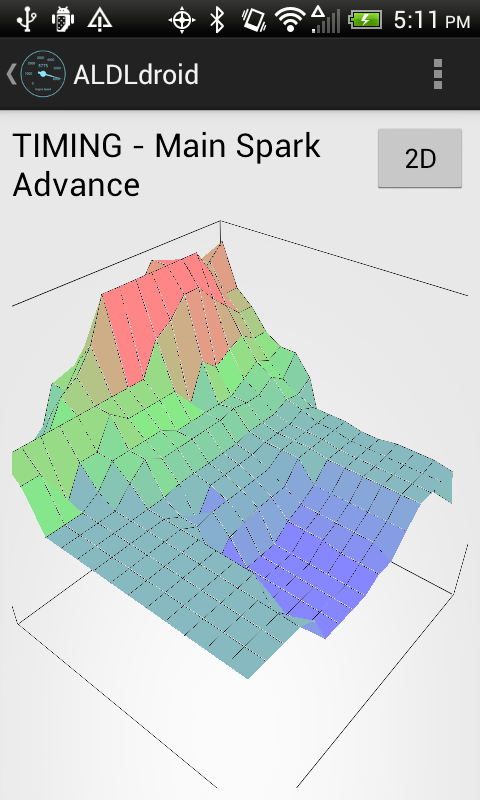
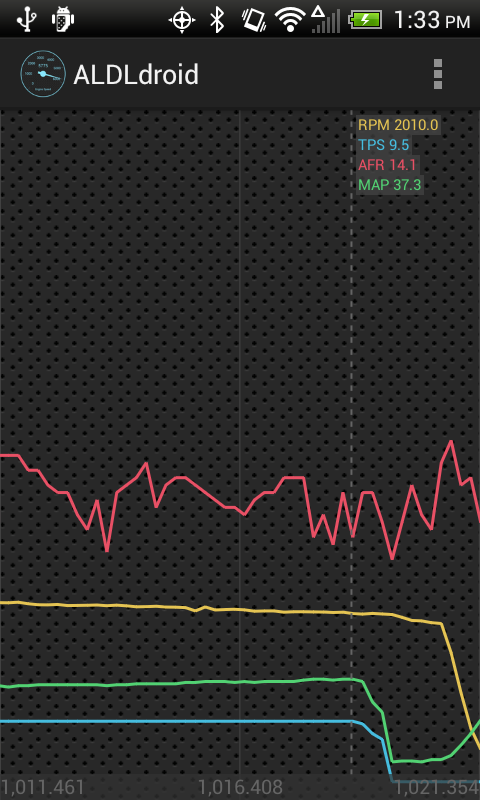
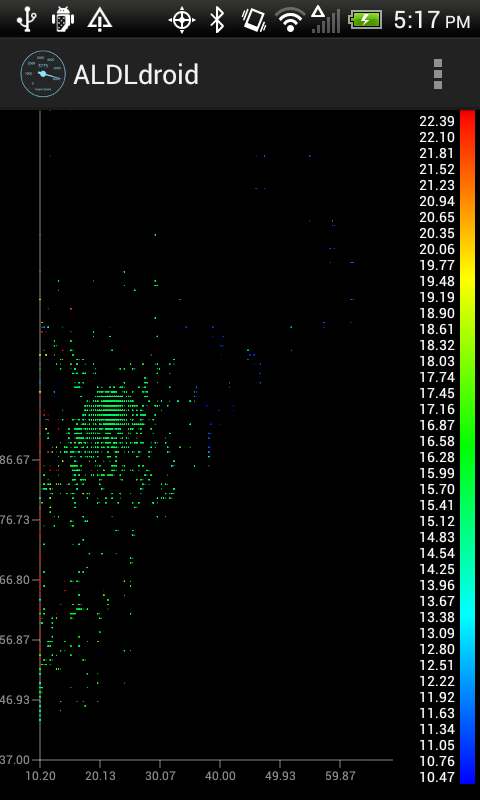
While the application was first developed for GM OBD-I ECUs, it uses a very flexible way of parsing ECU data stream that has proven useful to a lot of other car enthusiasts such as owners of BMW, Ford, DSM (Mitsubishi), Porsche, etc. The application also includes a complete tuning interface as well as data log file viewers which are in the form of time series, maps and scatter plots.
Learn More Download NowThe application has three big components: dashboards where data coming from the ECU can be displayed in various formats, a tuning section and data log file viewers.
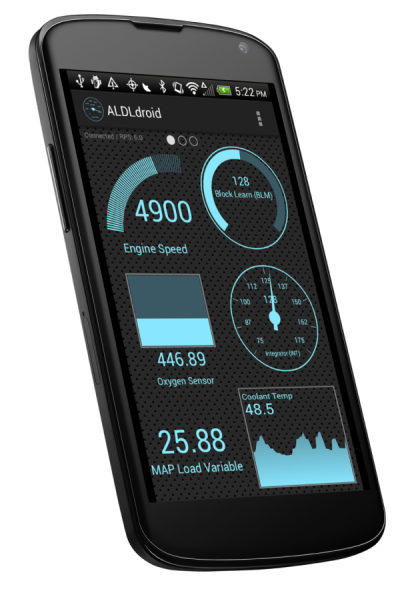
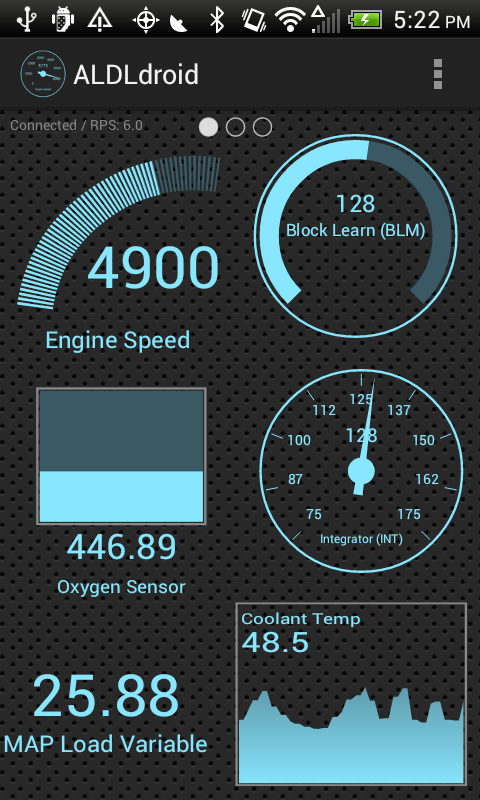
Customize the dashboards with any indicators you want to see
Android sensors on your device are used to display useful GPS geolocation data (including speed) as well as triple axis accelerometer data (including g-force)
Display the app in your windshield to see it at a glance
Look at the data you just data logged on your phone or tablet using the build-in time series, maps or scatter plot log viewers
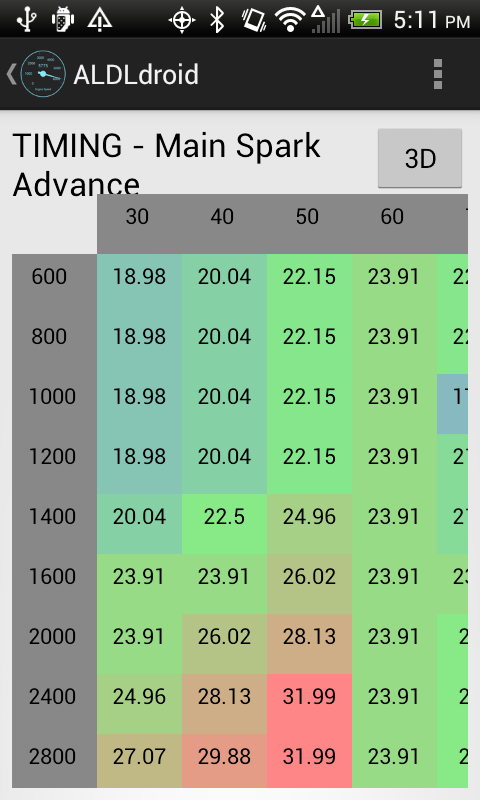
Tune on the fly using supported real-time tuning hardware or edit a binary file to program a chip later
We try to answer email from our customers as fast as we can, more often than not, we will answer within 24 hours
The application uses ADX and XDF files which are files from TunerPro (Windows software). These files can be found on various sites such as TunerPro Web site itself, GearHead EFI forums as well as your cars enthusiasts forums related to your specific vehicle.
Here is the easy steps that you can follow that will get you going
Find the ADX file for your vehicle. This is often the hardest part. Once your've found it, the rest is easy!
Install the ALDLdroid application from Google Play
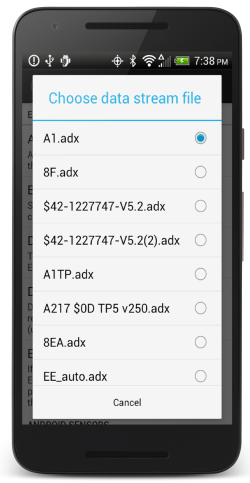
Use the Import Data stream feature of the application to import your ADX file.
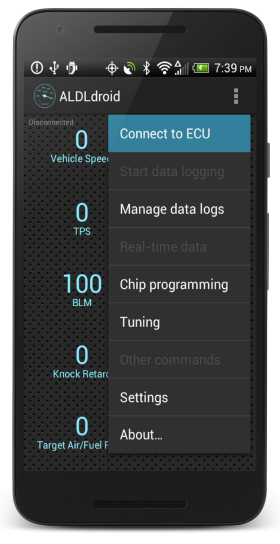
Connect the ALDL cable to your vehicle diagnostic port. Hit the Connect to ECU menu in the application and watch the data come in!
The application supports various hardware that can be wired or connected wirelessly to your Android device. Here is what is currently supported:
Wired connection (USB) and wireless (Bluetooth) are both supported by the app. For Bluetooth, we suggest the Red Devil River adapters (or the 1320 electronics if you can find one used) and for USB, any FTDI (USB chip) based cable will do. :obd2allinone should have what you need.
It is possible to program chip for your ECU using the Moates BURN1 (discontinued), BURN2 as well as AutoProm.
For real-time tuning, the application currently support the Moates hardware as well. That is the Ostrich as well as the AutoProm.
If you ECU is equipped with an NVRAM module for real-time tuning, that is also supported for some ECU. Mainly Australian ECUs at this point and more can be added as required.
Some of the features described above can be seen on the screenshots below.
We love to see what our customers do with our application so here a video of Boosted & Built Garage and his pretty awesome setup.
Many university civil engineering departments maintain licensed access to PCA publications for research and coursework.
Detailed explanations of load combinations, strength reduction factors (
While the official PCA Notes on ACI 318-11 and subsequent versions are often paid publications, several organizations provide related design guides and standards online: Resource Type Source / Provider University of Tehran (Archive) View ACI 318-14 PDF Design Examples StructurePoint (spSlab) ACI 318-14 Slab Design PCA Education Portland Cement Association PCA Resources Page Standard Previews American Concrete Institute ACI 318-14 Preview Significant Changes in the 2014 Code pca notes on aci 31814 pdf link
Resources like Scribd often host community-shared summaries or older PCA notes (such as ACI 318-05 or 318-11), which are useful for understanding foundational changes, although they should not be used for 318-14 design compliance.
If you are looking for a (e.g., shear strength, development length, or crack control). To understand any companion guide, you must first
To understand any companion guide, you must first understand the code it explains. ACI 318-14 was a landmark update that brought significant structural, organizational, and philosophical changes to the way concrete is designed.
These notes include practical examples, such as the design of rectangular reinforced concrete beams, taking the user through flexural, shear, and deflection checks, similar to the walkthroughs found in StructurePoint's educational resources . The ACI 318-14 code marked one of the
The ACI 318-14 code marked one of the most significant structural reorganisations in the history of the American Concrete Institute. Before 2014, the code was organized by design topics (such as shear, flexure, and axial loads). ACI 318-14 completely shifted to a (such as beams, columns, slabs, and walls).
Updates to strength reduction factors and strain limits.
: This paper by Anderson (2014) is essential for understanding the massive structural overhaul from the 2011 to 2014 version, moving from a behavior-based to a member-based organization.
If you are a student, researcher, or faculty member, your university library likely has an institutional subscription to engineering databases or physical copies of PCA literature.
Subscribe to our email newsletter for useful tips and resources.
Copyright 2026 ALDLdroid. All Rights Reserved.