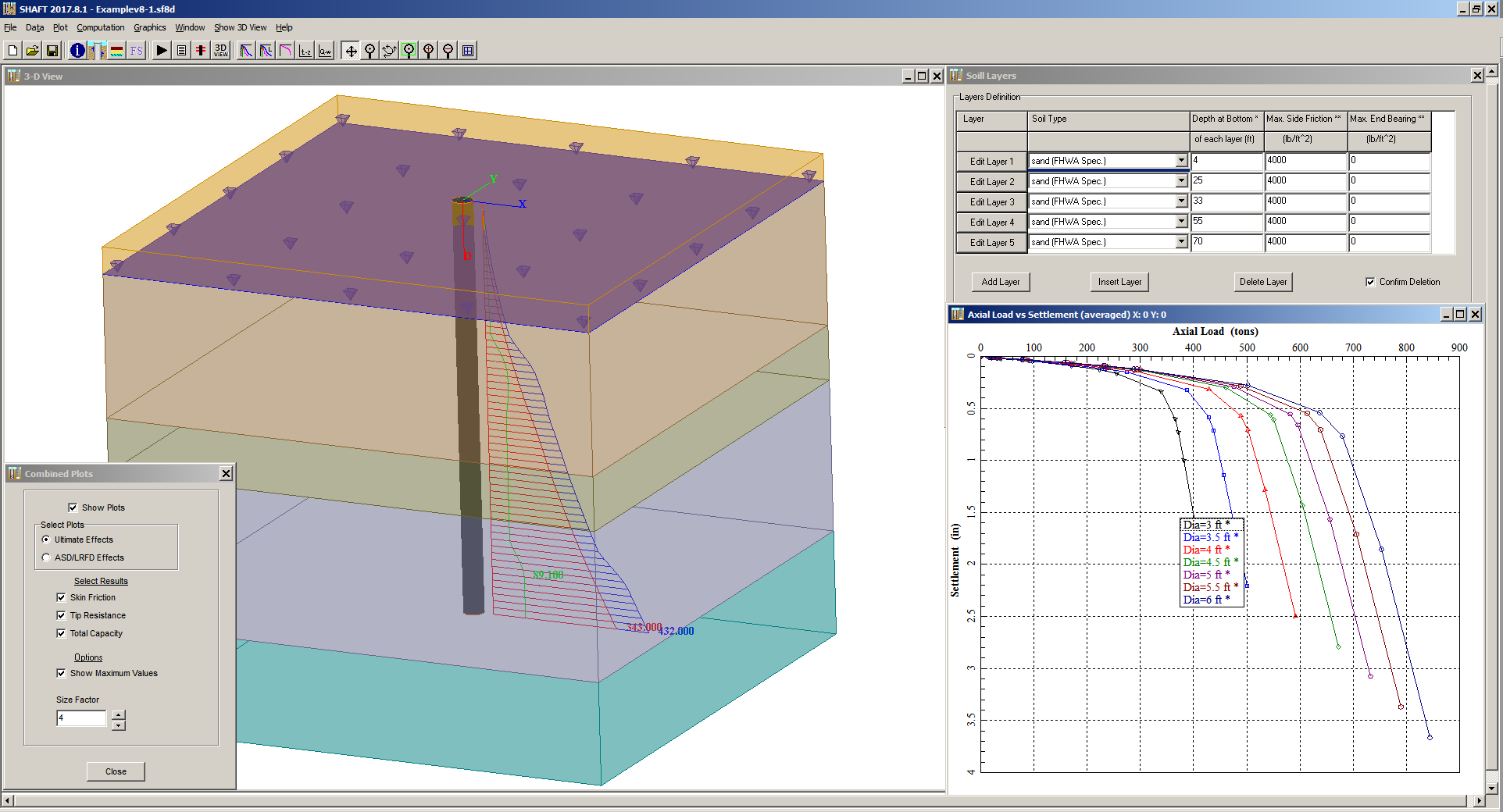
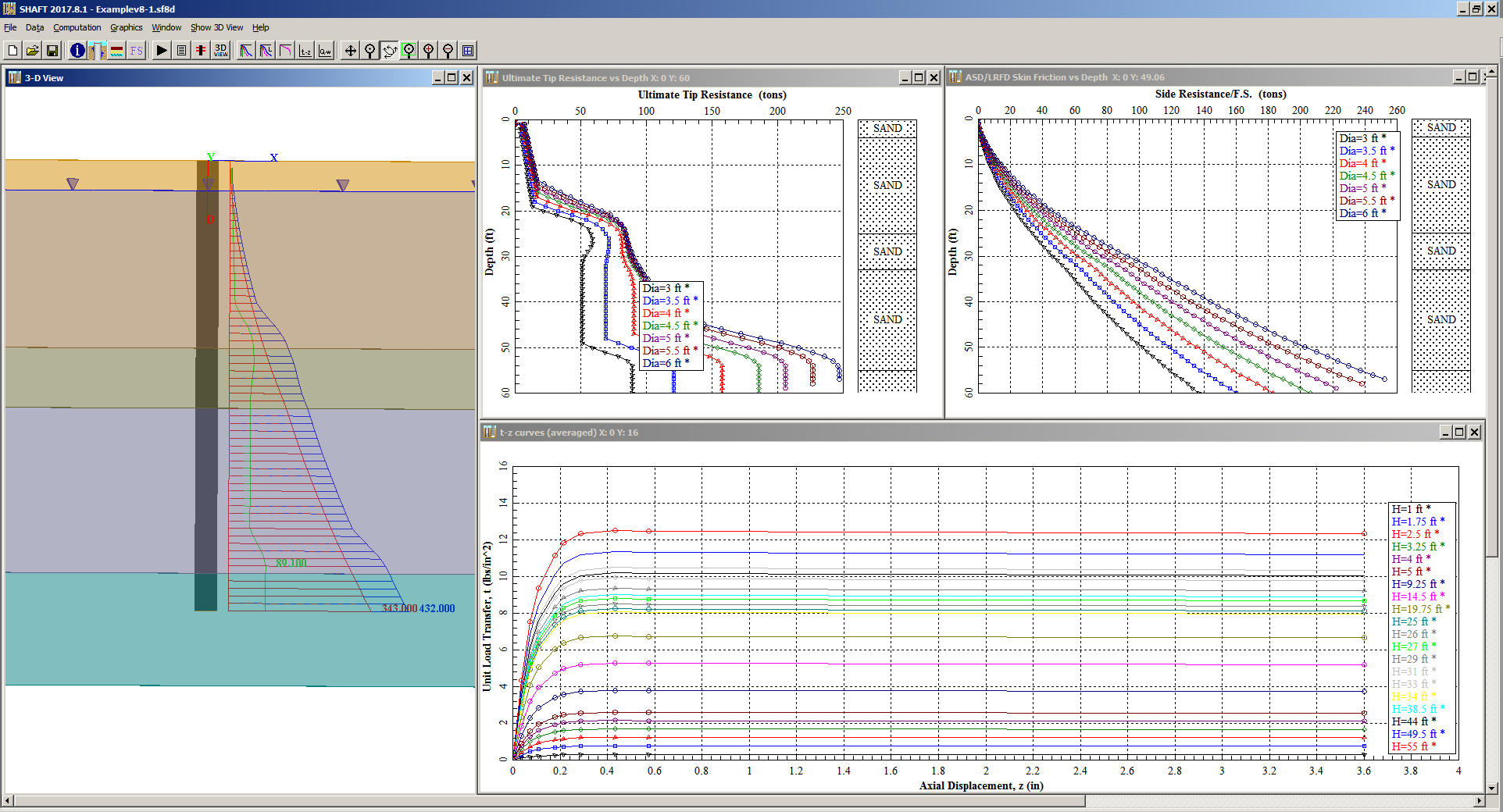
SHAFT is a computer program used to evaluate the axial capacity and the short-term, load-settlement curves of drilled shafts (bored piles) and continuous flight auger (CFA) piles or auger-cast piles (ACIP) in various types of soils. In general, the majority of axial capacity methods used by SHAFT are based on the latest FHWA manuals. In addition, several other axial capacity methods are provided for clay shales, gravels, and gravelly sands.
SHAFT can analyze the axial capacity and settlement behavior of drilled-shafts and ACIP piles in several types of soil and rock models. SHAFT can accommodate any combination of soil and rock layers in a layered profile. The soils and rock models in SHAFT are the following:
They worked furiously for four hours. The crack seemed to hold. The software didn’t crash, and the emulator fooled the authentication checks. They were outputting the final line diagrams for the turbine junction boxes when Elias noticed something odd.
Upon installation, the software checks for the presence of the dongle. The manual explicitly states: . This is a "software kill switch" built into the architecture. During installation, a configuration file (PROTECTION.XML) is placed in the software directory to guide the application on how to look for the license. The license code from a specific contract is programmed into the dongle, making each dongle unique to a user or company.
Research and whitepapers on integrating electrical installations into 3D environments for collision management and space optimization.
For professional reliability, it is always recommended to use the official version provided by the manufacturer or to explore open-source alternatives for electrical design if budget is a concern. SEE Electrical Expert V4 R1 Hasp HL Dongle see+electrical+expert+v4r1+dongle+crack+better
: Files labeled as "cracks" or "activators" are common delivery methods for malware, ransomware, and spyware that can compromise your entire network. Data Corruption
Cracked software frequently suffers from stability issues. A modified binary can crash unexpectedly, corrupting complex electrical schematics, wiring diagrams, and databases that took hundreds of hours to build.
The software launched. The familiar interface of SEE Electrical Expert flickered to life, the menu bars rendering in jagged lines before smoothing out. The status bar glowed green: Connected . They worked furiously for four hours
: V4R1 relies on rigorous data management frameworks. Patched binaries frequently corrupt component libraries, rendering schematic data unreadable by clients running legitimate versions. Comparison: Cracked Software vs. Legitimate Solutions SEE Electrical Expert Viewer V4R1 | IGE-XAO -- 793
In the case of SEE Electrical Expert V4R1, the dongle is required for activation and operation. Without the dongle, users are unable to access the software's features and functionalities.
In the realm of electrical design and engineering, software tools play a pivotal role in streamlining processes, enhancing precision, and facilitating collaboration. One such tool that has garnered attention is See Electrical Expert V4R1, a comprehensive solution for electrical design. Alongside its robust features, discussions around the use of a dongle and potential cracks have emerged. This post aims to provide an overview of See Electrical Expert V4R1, the role of a dongle, and the implications of software cracking. They were outputting the final line diagrams for
SEE Electrical Expert V4R1 is a comprehensive electrical design and simulation software that offers a wide range of tools and features for electrical engineers, designers, and manufacturers. The software provides a user-friendly interface that allows users to create and design electrical systems, including electrical circuits, wiring diagrams, and PLC programming.
If you want to transition your workflow to a more stable setup, let me know: Your current (Windows 10, 11, etc.)