yandex purenudism
yandex purenudism yandex purenudism
yandex purenudism
  Home
yandex purenudism
  About Us
yandex purenudism
  Products
yandex purenudism
  Process Models
yandex purenudism
  SE Resources
yandex purenudism
  Commentary
yandex purenudism
  Contact us
yandex purenudism
Breaking News!

A new blog ...

Yandex Purenudism ((hot)) -

Naturist spaces operate on a principle of equality. Without fashion brands or tailored clothing to signal socioeconomic status or fit into a specific subculture, people connect on a fundamentally human level. This equality fosters an environment where body judgment gives way to mutual respect. 3. Healing Trauma and Body Dysmorphia

Before discussing search , it's crucial to understand what is being searched. , or family naturism, is a branch of the broader naturist movement that emphasizes the non-sexual, wholesome aspect of social nudity , particularly within a family setting. Its core tenets include body positivity, a rejection of body shame, and living in harmony with nature. For many families, it's a lifestyle that they say fosters openness and acceptance. However, in the online world, the term has become highly contested.

The body positivity movement and the naturism lifestyle share a powerful, symbiotic relationship. At their core, both philosophies challenge societal beauty standards and promote radical self-acceptance. While body positivity emerged largely as a digital and social activist movement, naturism—the practice of communal non-sexual nudity—offers a physical, real-world application of these ideals. Together, they create a transformative framework for healing body image issues and reclaiming self-worth. The Intersection of Body Positivity and Naturism

Dismantling the commercialized beauty standards that profit off of insecurity. yandex purenudism

The moment you take off your clothes in a naturist setting, you will likely notice a wave of anxiety, followed almost immediately by an overwhelming sense of relief. You will quickly realize that nobody is staring at you; they are too busy enjoying their own freedom. Conclusion: Liberation in Its Purest Form

The Ultimate Liberation: How Body Positivity and the Naturism Lifestyle Intersect

Look in the mirror without judging or trying to "fix" your posture and angles. Naturist spaces operate on a principle of equality

Yandex + "pure nudism" (social/cultural practice): an overview of nudism/naturism, how a major Russian tech company like Yandex might intersect with related content (search, moderation, policies, legal/regulatory constraints in Russia), risks and compliance considerations.

Direct contact with the elements improves your neurological brain-to-body connection.

This normalization is the engine of genuine body acceptance. A core principle of naturism is non-judgment, both of oneself and of others. The first time a person participates in a social nude activity—whether at a designated beach, a club, or a hike—the initial experience is often marked by profound vulnerability and self-consciousness. However, this anxiety typically dissipates quickly, replaced by an unexpected feeling of freedom. The individual realizes that no one is staring, critiquing, or comparing. Instead, they encounter a community where a middle-aged man’s paunch, a woman’s mastectomy scar, and a young person’s acne are all simply unremarkable facts of existence. This daily, lived exposure to authentic, unadorned bodies acts as a powerful form of exposure therapy, systematically dismantling the internalized critical gaze. One learns to see their own body not as an object to be judged, but as a vessel for experience, capable of feeling the sun, the wind, and the water. Its core tenets include body positivity, a rejection

: Naturism is strictly non-sexual. It reframes nudity as a natural state of being rather than an invitation for sexual activity.

The art piece features a dreamlike scene where a figure stands amidst a sprawling, futuristic cityscape. The individual's body is subtly integrated with elements of nature, such as leaves and vines, which seem to be emerging from their skin. Their face is serene, with eyes closed, as if in contemplation.

So whether you try it at a hot spring, a nude beach, or just sleeping bare-skinned under a fan on a summer night:

Body positivity often leads to "body neutrality"—the practice of valuing the body for what it can do rather than how it looks. Naturism naturally fosters body neutrality. When swimming, sunbathing, hiking, or playing volleyball without clothing, the focus shifts to physical sensations. The individual feels the sun on their skin, the breeze, and the cool water without restriction. The body becomes a vessel for experiencing nature and life, rather than an object to be looked at and judged. The Psychological Benefits of Combining Both Lifestyles

In everyday life, clothes act as filters, status symbols, and tools for correction. Stripping away clothing removes the social hierarchy dictated by fashion and body shape. 1. The Power of "Passive Exposure"


 
The newest edition!
yandex purenudism Just Released!
Another
novel by
Roger Pressman!
yandex purenudism
Now available from McGraw-Hill!
Available in trade paperback and e-book editions. For more information, click here.

The seventh edition of Software Engineering: A Practitioner's Approach is intended to serve as a guide to a maturing engineering discipline. The seventh edition, like the six editions that preceded it, is intended for both students and practitioners, retaining its appeal as a guide to the industry professional and a comprehensive introduction to the student at the upper level undergraduate or first year graduate level.

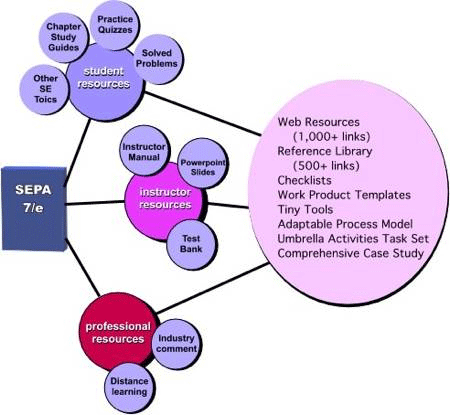
The seventh edition is considerably more than a simple update. The book has been revised and restructured to improve pedagogical flow and emphasize new and important software engineering processes and practices. In addition, a revised and updated “support system,” illustrated below, provides a comprehensive set of student, instructor, and professional resources to complement the content of the book.

yandex purenudism
The 32 chapters of the seventh edition have been reorganized into five parts. This organization, which differs considerably from the sixth edition, has been done to better compartmentalize topics and assist instructors who may not have the time to complete the entire book in one term.

Part 1, The Process, presents a variety of different views of software process, considering all important process models and addressing the debate between prescriptive and agile process philosophies. Part 2, Modeling, presents analysis and design methods with an emphasis on object-oriented techniques and UML modeling. Pattern-based design and design for Web applications are also considered. Part 3, Quality Management, presents the concepts, procedures, techniques, and methods that enable a software team to assess software quality, review software engineering work products, conduct SQA procedures, and apply an effective testing strategy and tactics. In addition, formal modeling and verification methods are also considered. Part 4, Managing Software Projects, presents topics that are relevant to those who plan, manage, and control a software development project. Part 5, Advanced Topics, considers software process improvement and software engineering trends. Continuing in the tradition of past editions, a series of sidebars is used throughout the book to present the trials and tribulations of a (fictional) software team and to provide supplementary materials about methods and tools that are relevant to chapter topics. Two new appendices provide brief tutorials on UML and object-oriented thinking for those who may be unfamiliar with these important topics.

The five-part organization of the seventh edition enables an instructor to "cluster" topics based on available time and student need. An entire one-term course can be built around one or more of the five parts. A software engineering survey course would select chapters from all five parts. A software engineering course that emphasizes analysis and design would select topics from Parts 1 and 2. A testing-oriented software engineering course would select topics from Parts 1 and 3, with a brief foray into Part 2. A "management course" would stress Parts 1 and 4. By organizing the seventh edition in this way, I have attempted to provide an instructor with a number of teaching options.
Software Engineering: A Practitioner's Approach
7th Edition
Table of Contents

Chapters

1. Software and Software Engineering

Part I - Process

2. Process Models
3. Agile Development

Part II - Modeling

4. Practice: A Generic View
5. Understanding Requirements (new chapter)
6. Requirements Modeling: Scenarios and Data (new chapter)
7. Requirements Modeling: Flow, Classes, and Behavior (new chapter)
8. Design Concepts (new chapter)
9. Architectural Design
10. Component-Level Design
11. Usability design (new chapter)
12. Pattern-based Design (new chapter)
13. WebApp Design

Part III - Quality Management

14. Quality Concepts (new chapter)
15. Software reviews (new chapter)
16. Software Quality Assurance
17. Software Testing Strategies
18. Testing Methods for Conventional Software (new chapter)
19. Testing Methods for OO Software (new chapter)
20. Testing Methods for WebApps
21. Advanced Verification Methods (new chapter)
22. Software Configuration Management
23. Product Metrics

Part IV - Project Management

24. Management Concepts
25. Process and Project Metrics
26. Estimation
27. Scheduling
28. Risk Management
29. Maintenance and Reengineering (new chapter)

Part V-Advanced Topics

30. Software Process improvement (new chapter)
31. Emerging Trends in Software Engineering (new chapter)
32. The Road Ahead
Appendix I - UML Tutorial (new)
Appendix II - OO Concepts (new)


Home About us Products Product Models SE Resources Commentary Contact us
Web site and all contents © 2001-2009, R.S. Pressman & Associates, Inc., All rights reserved.
Free website templates