
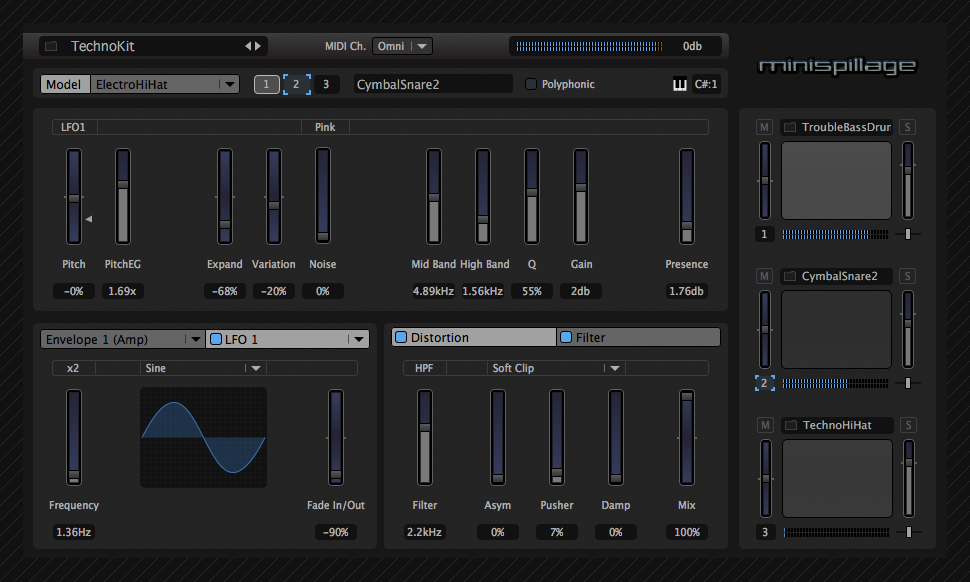

MiniSpillage is a free professional quality drum synthesizer plugin featuring high resolution 64-bit DSP processing.
MiniSpillage includes 3 exclusive drum synthesis algorithms along with distortion effects and resonant filters.
This PSU has known failure modes documented by the repair community. Here are practical solutions based on real-world scenarios.
Typically rated for high efficiency (often 80 Plus Gold or similar), as it is designed for stable office environments.
Powers the primary scalar IC, EEPROM (holding the firmware), and configuration strap resistors.
Often used for specialized peripheral power in HP SFF chassis. Common Maintenance & Troubleshooting d10240p1a schematic work
The schematic begins at the AC inlet, feeding directly into a dual-stage .
When replacing the PMIC, ensure the decoupling capacitors (
Found on the secondary side, crucial for converting high-frequency AC to DC. This PSU has known failure modes documented by
: In electronics, every component has a part number. This helps in identifying the component and its specifications.
is optimized for 12V-heavy systems, providing stable power to the motherboard, CPU, and SATA devices: Typically supplies the CPU and PCIe. +12V2: Typically supplies motherboard components. +5Vsb: 5-volt standby power (crucial for booting). 2. Analyzing the D10-240P1A Schematic Schematic work on the D10-240P1A
The D10240P1A schematic refers to a specific type of schematic diagram used in the design and development of electronic systems. The "D10240P1A" designation likely represents a particular device, module, or subsystem used in various applications. While the exact nature of the D10240P1A schematic is not publicly disclosed, it is clear that it has become a crucial component in many industries, including aerospace, automotive, and industrial automation. Powers the primary scalar IC, EEPROM (holding the
The unit uses a non-standard connector set designed specifically for HP motherboards rather than the standard 24-pin ATX format:
If you’ve been in the trenches of power supply repair or industrial board reverse engineering lately, you might have stumbled upon the elusive . At first glance, it looks like just another component ID on a crowded BOM. But once you pull up the schematic and start tracing the lines, things get interesting.
Fast-recovery Schottky diodes and low-ESR electrolytic capacitors smooth the transformer's output into stable DC rails.
Usually caused by a blown input fuse (F1) or a faulty bridge rectifier due to an overvoltage surge.
"A true wonder… The sheer range of sounds that can be coaxed from the instrument is nothing short of staggering."
Review by
Computer Music Magazine
"Awesome sound, intuitive work flow and—thanks to the powerful models—enormous flexibility."
Review by
Beat Magazine (Editor's Choice)